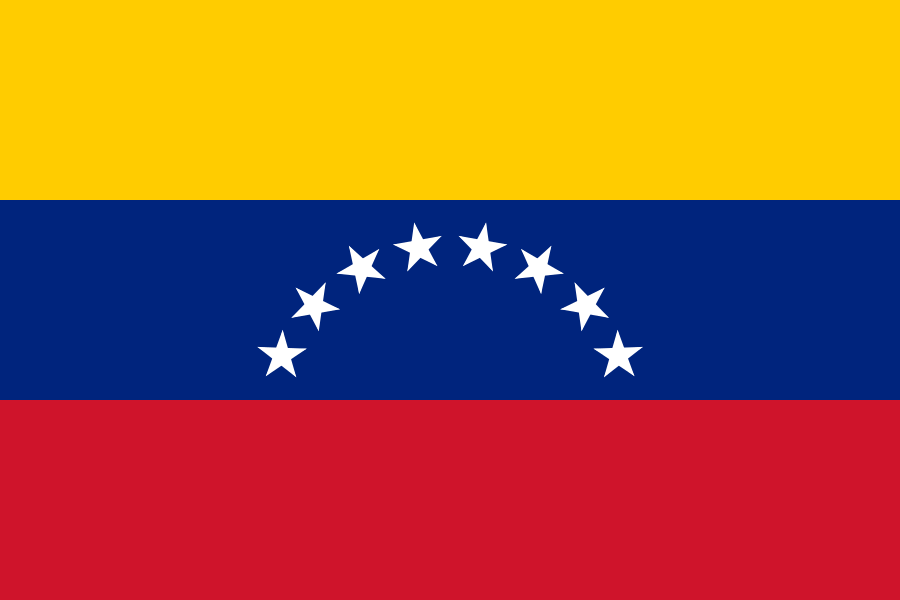
Venezuela
South America · Country #120
Did you know?
Venezuela is a country of striking natural diversity - home to the world’s highest waterfall, Angel Falls, which plunges nearly 1,000 meters from the tabletop mountain Auyán-tepui into the rainforest below.
My Experience
Getting to Venezuela was one of the biggest logistical challenges of my travels. With no functioning Venezuelan embassy in the United States, I had to fly to Barbados just to apply for a visa. After two trips to the island, an extraordinary amount of paperwork, and more than six months of waiting, it was finally approved. Even then, the adventure wasn’t over. After landing in Caracas, I was taken into a back room for questioning, where suspicious immigration officials asked me to record a video explaining why I had come to Venezuela.
In the end, every bit of the effort was worth it. Venezuela became arguably my favorite country I’d ever visited. Over two weeks, I explored everything from the Andean city of Mérida, where I hiked in the surrounding mountains and tried some of the country’s famous empanadas, to the German-founded mountain town of Colonia Tovar. By chance, I arrived during the town’s 180th anniversary celebrations, with traditional music, dancing, and German-inspired food filling the streets.
Caracas, Venezuela’s sprawling capital, offered yet another completely different side of the country. An Instagram follower who knew I was visiting connected me with her friend’s son, Rogelio, who spent a day showing me around the city. I also met Noa, a Japanese traveler who had spent six months exploring Venezuela and had become well known across the country for documenting his journey. Together we visited the slum of San Agustín, where we met John, an American-Venezuelan who had moved to Caracas to work with the United Nations on community development projects. Because of Rogelio, Noa, and John, I developed a much fuller picture of the city than I ever could have found on my own.
One of my most memorable days in the capital was visiting Petare, one of the largest and most dangerous slums in South America. I had connected with a local artist named Misa, who offered to show me around. When I arrived, he introduced me to his family and treated me to fresh golfeados, one of Venezuela’s most famous pastries. As we explored Petare together, he shared stories about its history, the violence that had shaped it, and his hope of changing its reputation by welcoming visitors into the community he loved.
As memorable as Caracas was, I already knew Canaima National Park would be the highlight of the trip. When I arrived at the lodge, I couldn’t believe who was there. Rich, a classmate from my eleventh-grade math class back in San Diego, was staying there with his twin brother, Mitch, and their family, who had returned to Venezuela to explore their homeland. Over the following days, we explored one of the most spectacular landscapes I’d ever seen. Towering tepuis rose above winding rivers and endless rainforest, creating the scenery that inspired the world of Avatar. Seeing Angel Falls, the tallest waterfall on Earth, cascading from the top of one of those ancient tepuis was every bit as unforgettable as I had imagined.
Venezuela reminded me that headlines rarely tell the whole story of a place. Behind the political turmoil and economic crisis was one of the most beautiful countries I’d ever visited, filled with remarkable people who welcomed me with extraordinary kindness.
Gallery


